Case Study
A family-owned property group in Hamburg that buys, develops and manages residential and commercial buildings for the long term.
Services
Document Processing
Workflow & CRM Integration

German Property Group in Hamburg
Industry
Real estate
Company Size
5 Employees
Timeline
6 Months
July 2025
The challenge
Across a portfolio of 150 buildings, the same filing structure repeated more than fifty document categories. Acquisition data rooms and day-to-day correspondence added around a thousand documents a month. Team members had to open each file, understand it and find the right destination. We began with the group’s existing structure and representative documents, so the workflow would reflect how the business organised its properties rather than impose a new filing system.

The approach
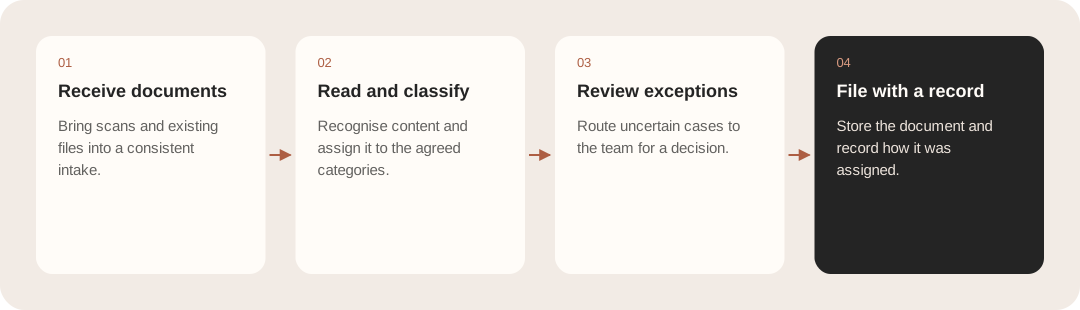
The workflow reads incoming documents, including older scans, and compares their content with the agreed categories. It connects the classification with the appropriate filing destination and records a confidence score. Uncertain cases are routed for a person to review instead of being treated as a confident decision. That distinction matters in property operations, where a misplaced permit, invoice or agreement can create work long after the initial filing.
A review path for every incoming document
The classification is only one part of the work. The system also needs to know where a document belongs and when its decision needs a second look.
Extract usable content from incoming files and scans instead of relying on the filename alone.
Compare the content with the company’s categories and identify the appropriate property and destination.
03
High-confidence items follow the filing path. Uncertain cases are held for a person to review.
Two outcomes, one consistent structure
Confident match → file and log. Uncertain match → human review. Both paths use the same agreed categories, keeping the team involved where judgement matters.
At a glance
From property documents to structured information, with source references and team review.
The details
What we built
An intake for documents from data rooms, scans and archives
Text recognition for scans and handwriting from long before anything was digital
Classification against the group's own filing structure, repeated for every building
A confidence score on every decision and a threshold the team controls
A review queue for the few documents a day that need a person
A log of what came in, where it was filed and why
How the project ran
First week: the filing logic taught to the system with five example documents
Pilot: tested on real documents, threshold tuned with the team
Rollout: extended to the full portfolio of buildings
Operation: daily use, with the review queue as the team's only touchpoint
The Results
What changed for the team
97 percent classification accuracy in daily operation
More than 80 hours of sorting a month removed
Around 30 documents a month reach a person, one or two a day
Every document filed with a confidence score behind it
Scans and handwriting from decades back handled
See a similar opportunity in your team?
We look at your process, your systems and the result you need. Then we agree a sensible first step, from assessing the opportunity to building and supporting it.
More cases.
Explore more of our work across systems, training and business processes.