_edited.png)
Proposal Turnaround: From 30 Days to 5
- Thanos Athanasiadis

- Nov 26, 2025
- 3 min read
Updated: Apr 18
The Challenge: A Bottleneck in Growth
For any service-based business, speed is currency. We recently partnered with a high-performance marketing agency facing a critical operational hurdle. Despite a healthy pipeline of leads, their conversion process was stalling.
The culprit? Manual, bespoke contract drafting.
Every time a new client showed interest, the sales team had to draft a custom contract from scratch. This manual workflow involved cross-referencing sales notes, adjusting service parameters, and multiple rounds of internal review. The result was a staggering 20–30 day turnaround time just to get a proposal into a prospect's inbox.
In a fast-paced performance marketing landscape, a month-long delay is often a deal-breaker. Prospects cooled off, momentum was lost, and the agency’s growth was artificially capped by their own administrative capacity.
The Solution: Productization & Intelligent Automation
Our approach wasn't to simply "speed up" the drafting, it was to fundamentally rethink how they sold and serviced clients. We implemented a three-phase transformation:

1. Service Productization
We worked with the agency to move away from purely custom contracts. This was one of the most challenging and time consuming parts of setting up the process, due to involving pricing, services, features, add-ons and strictly aligning with the organization’s teams to set their offerings in stone. We defined clear service tiers, standardizing parameters such as:
Budgets & Timelines: Pre-set ranges and duration options.
Deliverables: Defined "menus" of services (e.g., ad spend tiers, creative assets, reporting frequency).
Add-ons: Modular upsells that could be easily toggled on or off.
Combinations of services: when the client combined multiple services, discounts had to be applied. We mapped out all the service combinations and the applied discounts for each case
2. The "Client Profile" Template
We standardized the input data. Instead of scattered notes, we created a structured "Client Profile" template. This acted as a single source of truth, aggregating data from:
Initial inquiry forms.
Automated transcripts from sales calls.
Structured manual notes from sales reps.
3. The AI Matching Engine
This was the core of the automation. We built a custom matching engine that ingested the Client Profile and automatically recommended the best-fit productized services.
Input: Client needs (e.g., "Meta Ads," "€3.5k/mo budget").
Process: The engine mapped these needs to specific service tiers and add-ons.
Output: A fully drafted, customized contract generated in seconds, complete with correct pricing, timelines, and terms based on already set up contract templates.

The Workflow: From Chaos to Clockwork
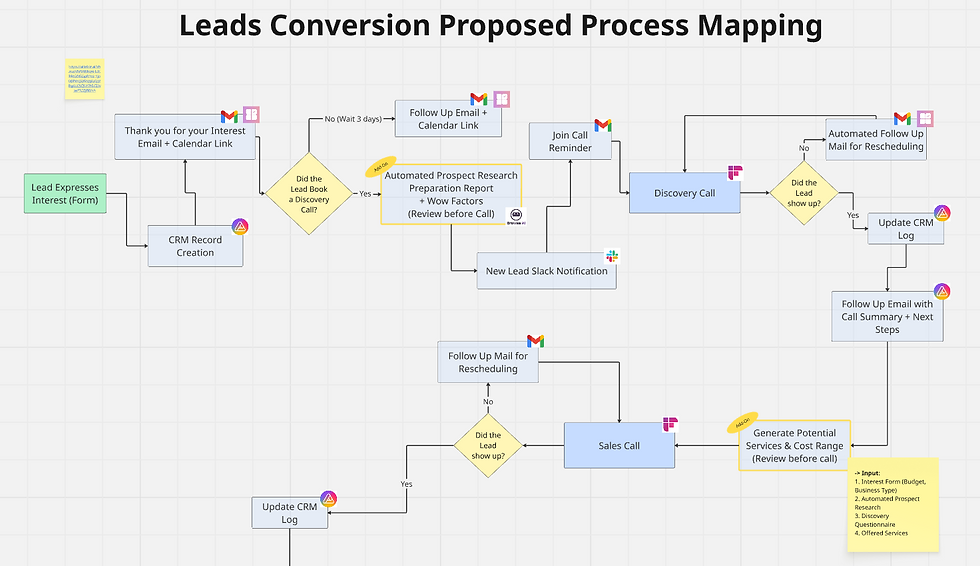
The new process looked like this:
Data Collection: Sales calls and forms automatically populate the Client Profile.
Auto-Matching: The engine proposes a service package.
Draft Generation: A complete contract is auto-generated.
Human Review: A team member reviews the draft (now taking minutes, not hours) and approves it.
Instant Delivery: The proposal lands in the client's inbox via DocuSign.
The Results: True Scalability Unlocked
The impact of this transformation went far beyond just "saving time." It fundamentally changed the agency’s business model.
Speed to Lead: Proposal turnaround dropped from 30 days to 2–5 days.
Operational Capacity: The team can now handle and onboard 5x more clients per month with the same headcount.
Revenue Impact: This increased capacity unlocked an additional €33,000 in potential monthly revenue.

Conclusion
Automation isn't just about efficiency; it's about scalability. By removing the manual friction from their sales cycle, this agency didn't just save hours: they unlocked a revenue engine that can finally keep pace with their ambition.
Ready to remove the bottlenecks in your business? Let’s talk.